

Introduction
I met Claire A. Rowan through a Goodreads Group where I happen to be a moderator among many talented people. I immediately took a strong liking to Claire’s demeanor and her conversations with our group members, so I decided to start reading her work. I was not disappointed, and by the beginning of March 2026, I had become a big fan of Claire A. Rowan’s Quiet Beginnings Series. Her books are truly soothing reads that rival the works of Sally Rooney, without the apathetic existentialism Rooney is known for, and seem more profound than some of Kristin Hannah’s best works. After March 2026 began, I knew I needed to have Claire on insaneowl.com right at the start of the new school year. I, therefore, welcome Claire A. Rowan to insaneowl.com and encourage all readers here to check out her Quiet Beginnings Series — I am sure you will by the end of this interview.
Biographical Details of Claire A. Rowan
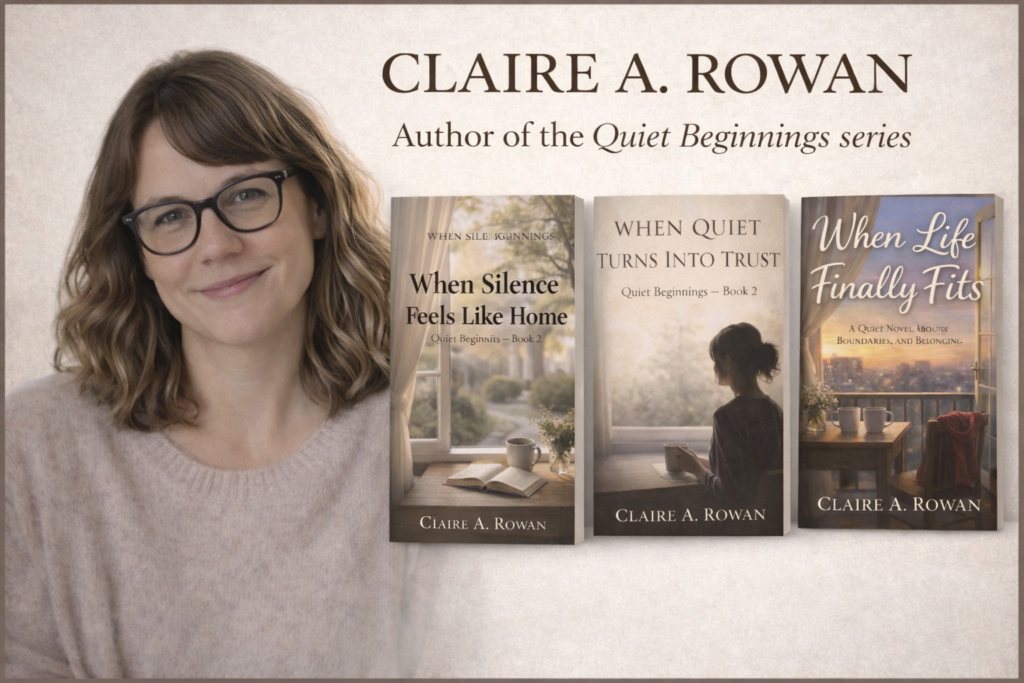
Claire A. Rowan is a contemporary fiction author and healthcare professional whose Quiet Beginnings series has captivated readers who believe that quiet love is the most powerful kind of love. Her books — ‘When Silence Feels Like Home’, ‘When Quiet Turns Into Trust’, and ‘When Life Finally Fits’ — are tender, slow-burning romances focused on single mothers, emotional healing, and the beauty of being accepted exactly as you are. I am excited to welcome her to insaneowl.com!
Interview
Fiza: Claire, welcome to insaneowl.com! I’m so excited to have you here. Before we dive into your beautiful Quiet Beginnings series, could you tell my readers a little about yourself—where you’re from, what your life looks like outside of writing, and what kind of person you were before becoming an author?
Claire: Claire A. Rowan is the name I use when I write stories about people who are quietly trying to rebuild their lives. I live in Europe and work in healthcare, so I spend a lot of time around real human experiences. Every day I see how people carry worries, hopes, and responsibilities that often stay invisible to the outside world.
Those moments have always stayed with me. Writing became a way to reflect on them and to understand them more deeply.
I am drawn to stories that grow slowly. I like relationships that develop through trust, patience, and small everyday moments rather than dramatic events. Many of my characters are people who feel tired or cautious, but who are still open to the possibility that life can become softer and more stable.
The Quiet Beginnings series grew from that idea. Sometimes the most important changes in life start very quietly. Only later do we realize that everything has slowly shifted.
Fiza: You work in healthcare, and your bio states that your experience has helped you observe emotional resilience and human connection, which often serve as the emotional core of your stories. Can you share a specific example from your work — without revealing any confidential information, of course — that has made its way into one of your books?
Claire: I have always liked stories, but I did not immediately think of myself as a writer. For a long time, writing was just something quiet and private, something I did when I needed to slow down and sort through my thoughts.
The first story I actually finished was a short slow-burn romance. It was not something I planned carefully. It started as a small idea about two people who meet at the wrong time in their lives, but slowly begin to trust each other.
While I was writing it, I realized how much I enjoyed exploring small emotional moments between characters. Not big dramatic scenes, but the quiet changes that happen when people begin to understand each other.
That story eventually became the beginning of my Quiet Beginnings series.
Fiza: Your literary influences are impressive — Colleen Hoover, Jojo Moyes, Kristin Hannah, Taylor Jenkins Reid, and Sally Rooney. That’s quite a lineup of storytellers! Which of these five authors do you think has most influenced the kind of writer you are, and why?
Claire: If I had to choose one, I would probably say Jojo Moyes has influenced me the most. What I admire about her writing is the way she builds emotional connection through ordinary moments. Her stories are not driven only by big dramatic events but by the quiet shifts between characters, the conversations, the small realizations that slowly change everything.
That approach resonates strongly with the way I like to write. I am interested in relationships that develop gradually and in characters who grow through everyday experiences rather than through constant conflict.
Of course, each of the other authors has influenced me in different ways. Colleen Hoover has an incredible ability to create emotional intensity. Kristin Hannah writes powerful stories about resilience and family. Taylor Jenkins Reid has a wonderful sense for voice and character. Sally Rooney captures subtle emotional tension in a very unique way.
But if I look at the kind of stories I naturally gravitate toward writing, the influence of Jojo Moyes is probably the closest to my own tone and storytelling style.
Fiza: When did you first truly realize that you were a writer? Was there a single moment or a specific sentence you wrote that made you say—yes, this is what I am meant to do?
Claire: I do not think there was one dramatic moment when I suddenly realized I was a writer. It happened much more quietly than that. At first, writing was simply something I returned to whenever I needed space to think or to make sense of emotions that were difficult to explain out loud.
The realization probably came while I was working on the first story that eventually became part of the Quiet Beginnings world. I remember noticing that I cared deeply about the characters and about the small emotional changes they were going through. I wanted to stay with them longer and understand them better.
At some point, I understood that writing was not just a passing idea or a hobby I would abandon after a few weeks. It was something I kept returning to, again and again, because it felt meaningful and honest to me.
So the moment was not a single sentence on the page. It was the quiet realization that telling these kinds of stories was something I truly wanted to continue doing.
Fiza: Let’s discuss the Quiet Beginnings series, which truly captures the essence of your writing journey so far. The series begins with ‘When Silence Feels Like Home’, a short prequel. What inspired you when you wrote that opening story? Was it always intended to be the start of a longer series, or did the world evolve beyond your initial ideas?
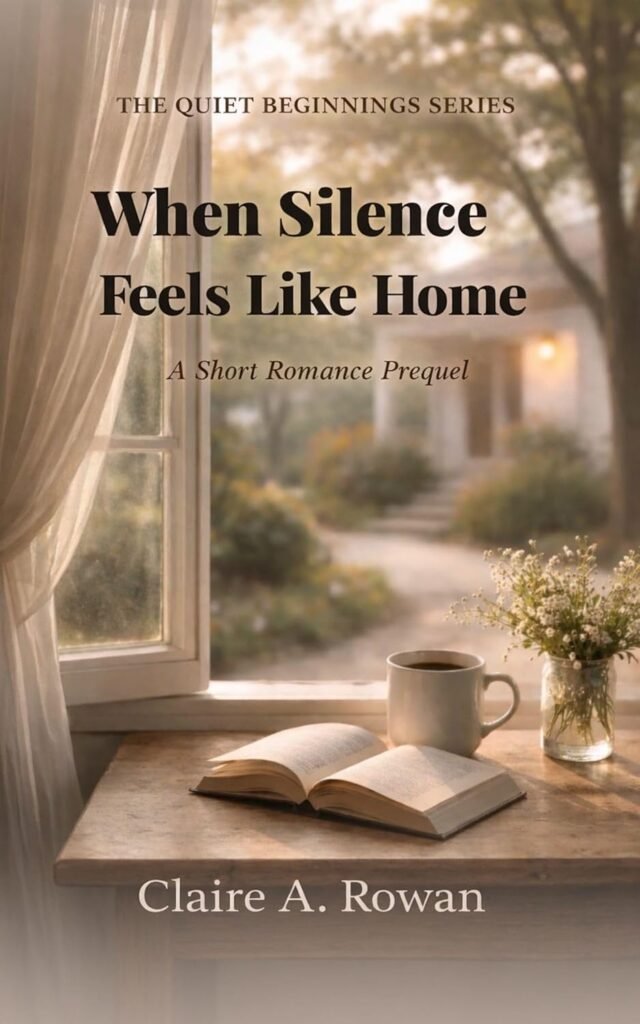
Claire: When I wrote When Silence Feels Like Home, I was not thinking about a series at all. It began as a small and very quiet story about two people who were both carrying emotional weight and did not yet know how to let anyone close to them.
At that time, I was interested in the idea that the silence between two people can mean many different things. Sometimes it is distance, but sometimes it is also a kind of understanding. That feeling became the heart of the story.
While writing it, I started to realize that the characters felt real to me in a way that made me curious about their lives beyond that first moment. I kept wondering what would happen to them later and how their relationship might grow once they began to trust each other more.
That curiosity slowly opened the door to a larger world. The story that was meant to be a single quiet piece eventually became the beginning of the Quiet Beginnings series.
Fiza: In ‘When Quiet Turns Into Trust’, we meet Elena — a single mother who, as you beautifully put it, does not fall in love; she survives. That word ‘survives’ is so powerful. Do you think surviving is an act of love in itself? And was Elena born fully formed in your imagination, or did she develop page by page?
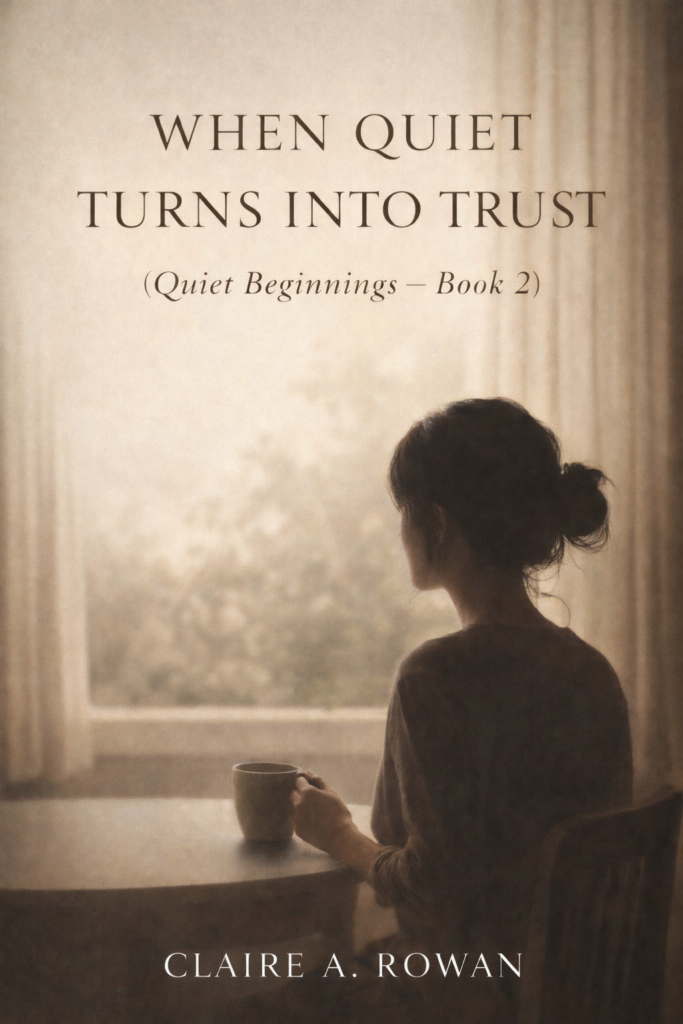
Claire: In many ways, I do think surviving can be a form of love. When someone keeps going despite exhaustion, disappointment, or fear, it often means they are doing it for someone else. For a child, for a family member, or simply for the hope that life might eventually become calmer and more stable.
That was the emotional space where Elena began. She is not someone who is looking for romance or dramatic change. Her first instinct is to protect the life she has managed to build for herself and for her child. Survival, for her, is about responsibility and quiet strength.
Elena was not fully formed when I first started writing. She grew slowly while I was working on the story. With every chapter, I understood a little more about what she had been through and why she had become so careful with her emotions.
By the end of the book, she was still cautious, but she had also allowed herself to trust again. For me, that felt like the most important transformation.
Fiza: Mark, Elena’s love interest in When Quiet Turns Into Trust, is described as a man who didn’t push, didn’t pry, and didn’t demand — he was just quiet company in a café. That’s such a gentle, genuine way for love to start. Where did the idea for Mark come from? Is quiet, steady love something you personally believe in?
Claire: Mark came from a very simple idea. I wanted to write about a kind of love that does not arrive with pressure or urgency. Elena had already been through enough in her life, so the last thing she needed was someone who would force his way into her world.
Mark represents the opposite of that. He notices her, but he respects the space she needs. He does not try to fix her life or rush her emotions. Instead, he simply stays present. Sometimes that kind of quiet presence can be more meaningful than grand gestures.
I do believe in that kind of love. Not the dramatic, overwhelming version we often see in stories, but something steadier. A relationship where two people slowly learn each other’s rhythms and where trust grows over time.
For Elena, that kind of love feels safe. And safety, for someone who has spent a long time just surviving, can be the beginning of something very powerful.
Fiza: The subtitle of When Quiet Turns Into Trust is A Single Mom Slow Burn Romance About Trust and Letting Someone Stay. That phrase — letting someone stay — is very emotionally charged. Why is it so hard for women like Elena to let someone stay? What must a man prove before he earns that right?
Claire: For someone like Elena, letting someone stay is not only about love. It is also about safety and responsibility. When a woman has learned to rely only on herself, especially while raising a child, her life becomes carefully structured around stability. Every decision affects more than just her own heart.
Because of that, trust is not given quickly. It has to grow slowly through consistent actions. A man does not earn that place through promises or dramatic gestures. What matters more is patience, reliability, and the ability to respect the pace of someone who has learned to be careful.
For Elena, the real question is not whether someone loves her. It is whether that person will still be there when life becomes complicated or ordinary. Stability is far more meaningful to her than intensity.
In that sense, letting someone stay becomes an act of courage. It means allowing another person to share a life that she has spent a long time protecting.
Fiza: Mark’s very first exchange with Elena includes the line – ‘I tend to narrate my poor decisions.’ That single sentence immediately makes him endearing without trying too hard to charm. Is Mark’s self-deprecating self-awareness something you planned for his character from the beginning, or did it develop naturally as you wrote him?
Claire: That line actually appeared very naturally while I was writing the scene. I wanted Mark’s first interaction with Elena to feel relaxed and human rather than carefully charming. Sometimes people try too hard to impress someone they are interested in, but Mark is not that kind of person.
His self-deprecating humor became a way to show that he is comfortable with himself and not trying to perform a role. He is aware of his own awkward moments and does not mind admitting them. That kind of honesty can make a character feel more real and approachable.
As I continued writing him, that quality stayed with him. Mark is someone who observes more than he speaks and who understands that trust grows more easily when there is no pressure. His humor is gentle and a little self-aware, which fits the story’s quieter tone.
In many ways, that small line helped define him. It showed that he was not there to impress Elena. He was simply there, being himself.
Fiza: Coffee in a quiet café or tea at home — where do you do your best writing?
Claire: Coffee, definitely. There is something about sitting in a quiet café with a cup of coffee that helps me focus. The background noise fades away, and I can concentrate on the story. It feels simple and comfortable, which is exactly the atmosphere I need when I write.
Fiza: Nina stands out as one of the best friends in modern romantic fiction — sharp, warm, funny, and almost always wise. Her advice: ‘If someone makes your life quieter instead of louder, maybe don’t run’ offers wisdom that goes beyond this novel. Where did Nina come from, and how do you create a truly wise best friend without turning her into just a plot device for Elena’s emotional growth?
Claire: Nina was partly inspired by someone in my own life. I have a friend who carries that same kind of sharp honesty and warmth. She is the kind of person who listens quietly and then says one simple sentence that suddenly makes everything clearer. When I was writing Nina, I often thought about that feeling.
I wanted Nina to feel like a real friend, not someone who appears only to give the right advice at the right moment. In real life, friendships are messy and alive. They include humor, teasing, small disagreements, and long conversations that have nothing to do with solving problems.
That is why Nina is sometimes supportive, sometimes blunt, and sometimes just present. I wanted her to exist as a person in Elena’s life, not as a tool to move the story forward.
Fiza: The phone call from Leo’s teacher in Chapter 13 of the book ‘When Quiet Turns Into Trust’ — informing Elena that Leo is struggling with transitions and needs to see a child psychologist — hits like a quiet catastrophe in the middle of an ordinary evening. Elena’s first instinct is to handle the whole situation herself and to keep Mark carefully distant from the process. How did you write that scene knowing that so many single mothers reading it would recognize that exact reaction?
Claire: I wrote that scene intentionally as a quiet moment rather than a dramatic one. The phone call itself is calm and almost routine, but for Elena it lands like something much heavier in the middle of an ordinary evening. Many single mothers recognize that reflex immediately. The first instinct is to handle the problem alone and to keep it contained before deciding who else should be involved.
Elena keeps Mark at a distance not because she does not trust him, but because that is the habit she has lived in for years. She has been the one responsible for every decision about Leo, especially the difficult ones. When the teacher mentions a psychologist, her first reaction is not panic but control. She tightens emotionally and starts organizing the situation in her mind before anyone else can step in.
While writing that scene, I kept thinking about how often mothers carry the quiet pressure to solve things on their own before admitting they might need support. Elena’s reaction is neither heroic nor tragic. It is simply familiar. Many readers recognize that moment of standing in the kitchen with a phone in their hands, already trying to figure out how to handle everything on their own.
Part of Elena’s journey in the story is slowly realizing that she no longer has to carry everything alone.
Fiza: Leo is the quiet heartbeat of ‘When Quiet Turns Into Trust’ — funny, perceptive, and almost always accurate about people. His acceptance of Mark is the simplest and most convincing endorsement of the character in the series. Was Leo’s voice hard to write, or did he speak to you clearly from the very first chapter?
Claire: Leo was actually one of the easiest voices for me to write. From the very beginning, he felt very clear to me. Children often see things in a much simpler and more honest way than adults do. They notice tone, small reactions, and the way people behave when they think no one is watching.
When I was writing Leo, I tried to keep that perspective. He does not analyze people the way Elena does. He just observes and reacts. In many ways he becomes a quiet emotional compass in the story.
His acceptance of Mark was important to me because children usually sense safety before adults are ready to admit it. Leo does not need a long explanation. He simply recognizes that Mark is calm, patient, and present. Sometimes that kind of instinctive trust is more convincing than anything the adults say.
Leo is still a child, of course. He is curious, funny, and sometimes blunt in ways that only children can be. But that honesty also allows him to see people’s true nature a little faster than the adults around him.
Fiza: In your third book, “When Life Finally Fits’, we meet Mara — a woman who is strong, capable, and always exhausted. I believe many of your readers will see themselves in her. Was Mara inspired by someone you know, or is she a blend of the many women you’ve observed in your life and work?
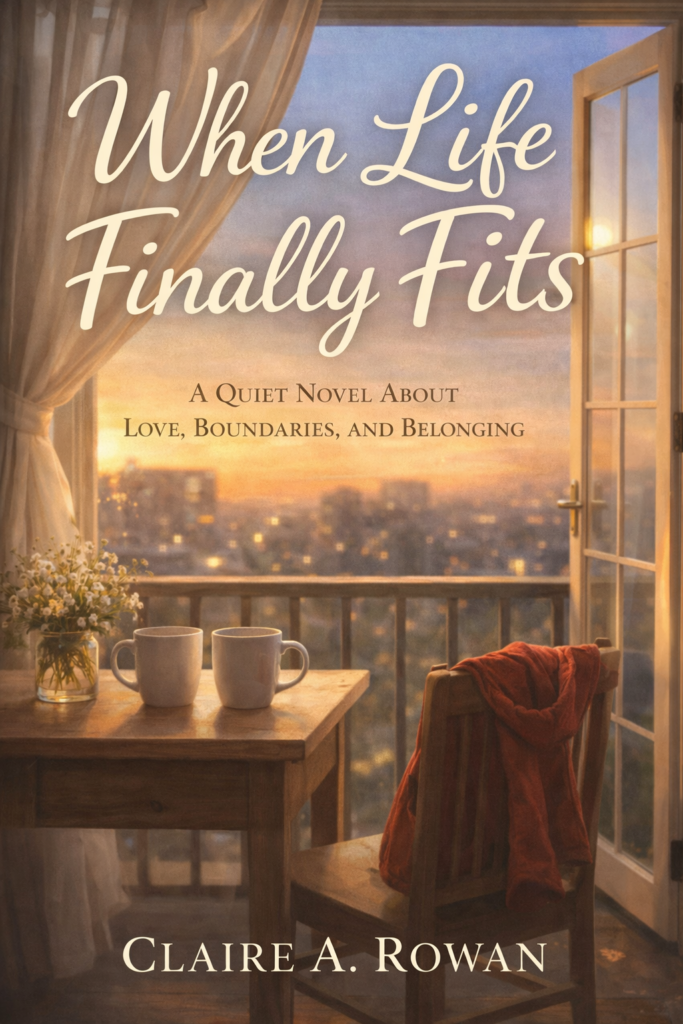
Claire: Mara was not inspired by one specific person. She is more a reflection of many women I have seen and known. Women who are strong, capable, and dependable, but also constantly tired because they carry so much responsibility. In some ways, I am also that woman in certain parts of my own life. I wanted her to feel real rather than idealized. Many women hold together work, family, and emotions every day, and that kind of quiet strength often goes unnoticed. In that sense, Mara represents many women, not just one.
Fiza: Your series is called Quiet Beginnings. The word quiet appears repeatedly in your titles — ‘When Silence Feels Like Home’, ‘When Quiet Turns Into Trust’. Why did you choose quiet? In a world full of loud, dramatic, high-stakes romance stories, what made you pick quiet as your signature?
Claire: I chose the word quiet very deliberately. For me, quiet does not mean empty or uneventful. It means the small moments where real change happens. Many real-life relationships are not dramatic or chaotic. They grow slowly through trust, patience and understanding. I wanted to write about that kind of love. In a world that often celebrates intensity and noise, quiet can actually be very powerful. It allows space for emotions, for healing, and for people to truly see each other. That is why quiet became the thread that connects the whole series.
Fiza: Between Elena and Mara — whose journey was more emotionally difficult for you to write?
Claire: Both characters were emotionally important to me, but Mara was more challenging to write. Elena’s journey is quieter and more internal, while Mara carries a heavier emotional weight. She is constantly balancing responsibility, exhaustion, and the quiet hope that life might still change. Writing her meant exploring that tension between strength and vulnerability. At times, it was difficult because I wanted her struggles to feel honest, not dramatic or exaggerated. Mara had to remain strong while also allowing the reader to see how tired she really was.
Fiza: If you could spend a day discussing craft with either Colleen Hoover or Kristin Hannah, who would you choose?
Claire: That is a difficult choice because both writers create very emotional stories, but I would probably choose Kristin Hannah. I admire the way she builds deep emotional journeys and complex female characters. Her stories often explore resilience, family bonds, and the quiet strength people discover in difficult moments. As a writer who is interested in emotional depth rather than just plot twists, I think a conversation with her about character development and emotional pacing would be incredibly valuable.
Fiza: If ‘When Life Finally Fits’ were made into a movie, who would you cast as Mara?
Claire: If ‘When Life Finally Fits’ were adapted into a film, I would probably imagine someone like Emily Blunt as Mara. She has a remarkable ability to portray strong women who carry a lot beneath the surface. Mara is not dramatic in an obvious way. Much of her story lives in quiet moments, small expressions, and the weight of responsibility she carries every day. I think Emily Blunt could beautifully capture that mix of strength, exhaustion, and quiet resilience.
Fiza: ‘When Life Finally Fits’ begins with a powerful domestic image – Mara pressing a sagging fridge calendar flat with her hand and then letting it go. That calendar reappears near the end of the novel as a subtle symbol of her emotional growth. Was that recurring image planned from the very start as a structural motif, or did it develop naturally as you wrote?
Claire: That image wasn’t originally planned as a strict structural symbol. It appeared very early while I was writing the opening scene, almost instinctively. I liked how something so ordinary—a slightly crooked fridge calendar—could quietly reflect Mara’s internal state. Her life looks organized on the surface, but in reality nothing is really holding together.
As the story developed, I realized the calendar carried emotional weight. It became a subtle way to show how Mara relates to control, expectations, and the idea that life should follow a clear plan.
By the time the image returns near the end of the novel, it naturally reflects her growth. Nothing dramatic changes about the object itself, but Mara’s relationship to it does. She no longer tries to force everything back into place. She’s learned that life doesn’t always need to fit perfectly in order to feel right.
Fiza: You chose a broken elevator — of all the possible settings in the world — as the meeting place for Mara and Jonah. He arrives in her life carrying a cardboard box too heavy with books, and they climb five floors together without ever deciding to. There is such quiet symbolism in that scene. Was the stairwell always the setting, or did you try other options for the first meeting before settling on this one?
Claire: The stairwell was actually there from the very first draft. I didn’t consciously design it as symbolism at the time. I simply needed a small, believable moment in which two strangers would be forced to spend a little time together. A broken elevator felt ordinary and slightly inconvenient, as real life often is.
But as I wrote the scene, the setting started to carry its own quiet meaning. They are literally climbing upward together, step by step, without planning to. Neither of them is trying to impress the other. They are just two tired people sharing a simple, practical moment.
The box of books also mattered to me. Books are weight, memory, and history. Jonah arrives carrying all of that before Mara knows anything about him. She just sees a man struggling with something heavy and decides to help.
That felt honest for the kind of relationship I wanted to write about. Not dramatic or cinematic. Just two people meeting in a small, inconvenient moment that slowly becomes important.
Fiza: Eli is one of the most remarkable child characters I’ve encountered in modern romantic fiction. He has his own chapter points of view, notices when the house breathes differently, and draws pictures instead of asking questions directly. His observation that people call things bad when they don’t know what to do with them is one of the wisest lines in the novel. Did you plan Eli’s chapters from the start, or did he insist on having his own voice as you wrote him?
Claire: Eli’s voice was present very early in the writing process. At first, I didn’t plan for him to have full point-of-view chapters. I thought of him mostly as part of Mara’s world, someone who would quietly shape the emotional atmosphere of the story.
But as I kept writing, I realized that Eli noticed things the adults didn’t. Children often see emotional shifts before anyone explains them out loud. Giving him his own perspective allowed the story to show those subtle changes in a different way. He observes the world without the layers of explanation and defense that adults usually carry.
His drawings, instead of direct questions, came from that idea. Children sometimes express what they feel indirectly, through small details, images, or simple comments that reveal more than they realize.
Once I heard his voice clearly on the page, it felt natural to give him space in the narrative. His chapters became a quiet counterbalance to the adult characters, reminding the reader that emotional truth is often simplest when seen through a child’s eyes.
Fiza: Jonah is offered the Berlin assignment — three months, a career-defining opportunity his past self would have called responsible. He declines it entirely, telling his supervisor that his life is different now. Did you always know Jonah would refuse Berlin? Or was there a version of the manuscript where he accepted — and if so, how much did the story change as a result?
Claire: From the beginning, I knew that Jonah’s real conflict wasn’t about ambition or career. It was about learning how to stay. Earlier in his life, choosing the Berlin assignment would have been the responsible decision, the kind that looks right from the outside. But by the time that opportunity appears in the story, Jonah is no longer the same person who would automatically choose distance over connection.
I never seriously wrote a version where he accepted the assignment. The emotional direction of the story was always moving toward presence rather than escape. For Jonah, refusing Berlin isn’t a sacrifice. It’s a recognition that the life he wants is already forming where he is.
What mattered to me was that the decision felt quiet and clear. He doesn’t make a dramatic speech or frame it as a heroic choice. He simply understands that the version of success he used to chase no longer fits the life he is building.
Fiza: What was the last book that made you cry?
Claire: One book that made me cry was The Nightingale by Kristin Hannah.
I’m always moved by stories where love and courage appear in very ordinary moments.
Fiza: The one book you wish you had written — just one title, please!
Claire: If I had to choose just one, it would be The Nightingale by Kristin Hannah.
Fiza: Your author bio says you write in a calm, reflective style that emphasizes emotional depth over heightened drama. But quiet books can be extremely challenging to write — there’s no external plot machinery to propel the reader forward, only the inner lives of characters. How do you keep the reader turning pages when the story is intentionally slow and deliberate?
Claire: That’s a very real challenge with quiet stories. When the plot isn’t driven by dramatic events, the movement has to come from the characters themselves.
For me, the momentum comes from small emotional shifts. A conversation that changes how two people see each other. A moment where a character realizes something about their past. Or a quiet decision that slowly alters the direction of their life.
Even when the story feels calm on the surface, something inside the characters is always moving. They are reconsidering, remembering, resisting, or finally allowing themselves to feel something they avoided before.
Those subtle changes create a different kind of tension. The reader isn’t waiting for something explosive to happen. They are waiting for the moment when the characters finally understand themselves or each other.
And when that moment arrives, it often feels more powerful precisely because the story took its time getting there.
Fiza: Single motherhood is a major theme throughout your series. What led you to choose single mothers as your heroines? Is this a personal passion, a gap you saw in the romance market, or did the characters call for it from you?
Claire: It started with the characters.
When I began shaping the early ideas for the series, the women who appeared in my mind already had complicated lives. They were not at the beginning of adulthood. They had responsibilities, histories, and in many cases someone else depending on them.
Single motherhood naturally carries that kind of emotional weight. It changes how a woman makes decisions, how she protects herself, and how cautiously she approaches love. Romance is no longer just about attraction. It is also about trust, stability, and the safety of a child’s world.
From a storytelling perspective, that creates a very rich emotional landscape. Every relationship matters more, every choice carries consequences, and love has to grow in a way that respects the life that already exists.
I also felt that many romance stories focus on people who are still building their lives. I was more interested in characters who are rebuilding them.
That is where the emotional depth comes from.
Fiza: How long does it usually take you to write a book? Do you plan carefully, or do you discover the story as you go? Are you a plotter or a pantser — or something beautifully in between?
Claire: For me, it’s usually something in between.
I tend to start with a clear emotional direction rather than a fully detailed plot. I know who the characters are, what they carry within them, and where their emotional journeys might lead. But I rarely outline every scene in advance.
As I write, the story often reveals itself through the characters’ choices and reactions. Sometimes a small moment or a line of dialogue opens a path I hadn’t planned, and the story grows naturally from there.
Because my books are quiet and character-driven, I pay close attention to the rhythm of emotions and relationships rather than to strict plot points. So I suppose I’m a planner in spirit but a discoverer in practice.
In terms of time, a book usually takes me several months to complete, depending on how complex the story becomes as it unfolds.
Fiza: Your book ‘When Life Finally Fits’ is narrated from multiple perspectives — we switch between Mara, Jonah, and Eli, with each voice clearly distinct. Eli’s chapters resemble prose poetry—short, filled with metaphors, and focused on his observations rather than on understanding. How do you transition so smoothly between an adult woman’s exhausted interiority, a man confronting his past, and a ten-year-old boy who interprets the world through patterns and observations?
Claire: Shifting between those voices was less about technique and more about perspective.
Each character experiences the same world, but they interpret it differently. Mara moves through the story from a place of exhaustion and responsibility. Her thoughts tend to circle around practical things—safety, stability, the quiet fear of making the wrong decision for her child. Her interior voice is heavier because she carries more history.
Jonah’s perspective is different. His chapters often revolve around memory and confrontation with the past. He notices spaces, objects, and silences that remind him of what he left unresolved. His voice needed to feel restrained, almost careful, because he is a character who thinks before he speaks.
Eli, on the other hand, doesn’t analyze the world in the same way adults do. Children often observe patterns before they understand meanings. That’s why his chapters lean toward short, almost poetic fragments. He notices how the house sounds at night, how adults pause before answering questions, how certain emotions change the atmosphere of a room. He may not fully interpret those things, but he feels them.
So the shift between voices comes from asking a simple question for each scene: How would this particular person notice the moment?
Once the answer to that is clear, the language tends to follow naturally.
Fiza: Your books are available on Kindle Unlimited, and you have a private reader list where you share bonus scenes and early excerpts. That is such a generous, personal way to connect with readers. What does hearing from a reader mean to you? Has a reader ever written to you and made you cry?
Claire: Hearing from readers is one of the most meaningful parts of writing for me.
When you write quiet, reflective books, you also accept that they will not be for everyone. Some readers expect a stronger external plot or more overt drama, while my stories tend to move more slowly and focus on the characters’ inner lives.
So I understand when someone feels the book is too quiet or too slow. That reaction is part of the conversation between a story and its readers.
At the same time, when someone truly connects with the book’s emotional layer, it means a great deal to me. Fiza Pathan, who runs a literary blog and kindly sent me these interview questions, wrote about how she understood the novel, and the depth of her interpretation genuinely moved me. Seeing the story reflected back through such a thoughtful reading reminds me why I write these kinds of quiet stories.
I also receive very different reactions. One reader once wrote to me saying they did not understand why Mara did not react more dramatically when she became pregnant. They wondered why she did not feel the urge to slap Jonah and tell him to “be a man” and take responsibility immediately. For that reader, emotional depth meant a stronger outward reaction.
But for me, the complexity of people often lives somewhere quieter. Human emotions are rarely simple. People can feel anger, fear, tenderness, and uncertainty at the same time. Sometimes the most complicated emotions are the ones that remain unspoken.
That range of responses is actually one of the things I find most fascinating about sharing a book with readers.
Fiza: If a reader has never read a Claire A. Rowan book before — maybe they’re used to fast-paced, dramatic romance — what would you say to encourage them to check out the Quiet Beginnings series?
Claire: If someone is used to fast-paced, dramatic romance, I would probably say this: Quiet Beginnings is a different kind of reading experience.
The stories are not built around big twists or dramatic confrontations. Instead, they focus on the quieter moments where people slowly begin to trust again, where relationships grow in small, meaningful steps.
If a reader enters the story expecting constant action, the book might feel slower at first. But if they allow themselves to settle into the rhythm of the characters’ lives, they may discover a different kind of tension — the kind that comes from emotional honesty, from complicated feelings, and from the slow rebuilding of trust.
The world of Quiet Beginnings is about ordinary people who carry history, responsibility, and sometimes quiet wounds. Love in these stories is not sudden or overwhelming. It is careful, patient, and deeply human.
So I would invite readers simply to slow down with the characters for a while. Sometimes the quietest stories are the ones that stay with us the longest.
Fiza: You mentioned that a new quiet love story is on the way. Without revealing too much, can you share anything at all—a theme, a feeling, or a single image from the new book that already resides in your heart?
Claire: What I can share about the new story is that it still carries the quiet emotional core that readers know from my books, but it moves a little faster and opens more toward the outside world.
The emotional stakes are stronger, and the characters are forced to confront things that cannot remain quiet forever. There is still reflection and interior life, but the story also includes more events and circumstances that push the characters forward.
At its heart, the book explores how the past continues to shape people even when they believe they have moved on. Some truths remain buried for years, quietly influencing relationships until the moment they finally surface.
If I had to describe it with a single image, it would be two people sitting across from each other in a quiet room, realizing that the story they believed about their past may not be the whole truth.
So while the emotional depth and reflective tone remain, this new story carries a slightly stronger current beneath it.
Fiza: ‘When Life Finally Fits’ explores pregnancy as a quiet, deeply physical experience — the smell of coffee fading, the fatigue that doesn’t lift with sleep, the body speaking a language its owner is still learning. Many pregnancy stories are either comedic or melodramatic. You chose something quite different — almost meditative. Was that a deliberate artistic decision, and did you draw from personal or professional experience to write those chapters?
Claire: Yes, that was a very deliberate choice.
Pregnancy is often portrayed either as something comedic or as a dramatic turning point in a story. But in reality, for many women, it unfolds much more quietly. It is deeply physical, gradual, and sometimes confusing. The body begins to change and respond in subtle ways at first, and the person experiencing it is still learning to understand those signals.
I was interested in writing pregnancy as an interior experience rather than a dramatic event. The small details — the sudden aversion to a familiar smell, the heaviness that sleep does not completely fix, the sense that the body is moving slightly ahead of the mind — felt more truthful to me.
Because my stories focus on emotional and physical awareness, a more meditative tone seemed natural for those chapters.
And while fiction always requires imagination, my professional background in healthcare also helped me think more attentively and observantly about pregnancy. It allowed me to approach those moments with a sense of realism and respect for the body’s quiet complexity.
Fiza: The broken elevator or the sagging fridge calendar — which image in ‘When Life Finally Fits’ are you most proud of?
Claire: That’s a difficult choice, because both images represent something important about the emotional atmosphere of the story.
But if I had to choose, I would probably say the sagging calendar on the fridge.
It’s such a small detail, but it quietly reflects the way life sometimes slips out of the order we try to impose on it. Calendars are meant to represent plans, structure, and control. When it hangs slightly crooked, held by a tired magnet, it suggests that the routines people depend on are already beginning to loosen.
For me, that image captured the characters’ emotional state at that moment. They are still trying to keep things orderly and predictable, but underneath, something in their lives is already shifting.
I’ve always loved those quiet visual details that carry a little more meaning than they seem to at first glance.
Fiza: Which detail from ‘When Quiet Turns Into Trust’ do you love most — the wobbling chair or the yellow sock?
Claire: I have a soft spot for the yellow sock.
Small, slightly imperfect details like that often carry a surprising emotional weight. The yellow sock is such an ordinary object, but it quietly reflects the reality of the characters’ lives. It reminds the reader that life in that house is not perfectly arranged or polished. It is lived in — a little messy, a little unpredictable, but very real.
Moments like that help ground the story. They show that love and trust do not grow in dramatic settings. They grow in everyday spaces, surrounded by small signs of ordinary life.
That is the world I wanted ‘When Quiet Turns Into Trust’ to live in.
Fiza: What one word best describes the Quiet Beginnings series?
Claire: If I had to choose just one word, it would be healing.
The Quiet Beginnings series is less about dramatic beginnings and more about what happens after life has already left its marks. The characters carry history, mistakes, responsibilities, and sometimes quiet wounds. The stories explore how people slowly find their way back to trust, stability, and connection.
In that sense, the heart of the series is not just romance; it is healing.
Fiza: You recently read my short story ‘Caste Metal,’ which is set during the pre-Independence era of the Indian Caste System. How did that story make you feel, and how was it different from your own fiction?
Claire: Reading Caste Metal left me with a quiet sadness that lingered long after I finished the story. What moved me most was Cacchar himself, a boy whose love for reading becomes the very reason he is punished.
As I read, I felt a mix of compassion, helplessness, and quiet anger. What happens to his mother and sisters is extremely difficult to witness, and what hurt even more was the silence of the people around them. Violence is treated as part of the natural order, and that realization makes the story deeply unsettling.
At the same time, the story also shows how powerful knowledge can be. Cacchar’s desire to read becomes an act of courage in a world that fears understanding. In the character of Kalamana, there is also a small but powerful moment of humanity, a reminder that sometimes one person can interrupt cruelty.
It is very different from the kind of fiction I usually write. My stories tend to explore quieter emotional lives and the slow rebuilding of trust between people. Caste Metal confronts a historical injustice directly and shows the brutal weight of a social system.
What stayed with me most is the feeling that even in a world shaped by cruelty, compassion and education still hold the possibility of change. Reading your story reminded me that literature can do more than tell a story. It can also confront injustice and give dignity to voices that history tried to silence.
Fiza: Among my short stories, ’Caste Metal’, ‘My Sweet Lord’, and ‘Until Death Do Us Unite’—which one do you think should be turned into a full-length novel, and which one should be completely abandoned?
Claire: Reading your three stories, I felt that Caste Metal has the strongest potential to grow into a full-length novel. The world it introduces already feels large and complex. The political tension, the religious conflict, and the personal tragedy at the center of the story create the sense that we are seeing only one moment inside a much wider historical struggle.
The opening scene, where the Buddhist monk sets himself on fire in the middle of the street in Dil-e-bad while shouting for the rights of his people, is unforgettable and immediately establishes a powerful moral crisis in the society around him. It raises many questions about the lives of the Buddhist minority and the forces that pushed someone to such an extreme act.
Because of that, I could easily imagine a novel that explores the background of that conflict and the lives of the people connected to it. There is a much larger story waiting behind that moment.
At the same time, My Sweet Lord and Until Death Do Us Unite feel very effective as short stories. Their power comes from the intensity and clarity of a single idea or emotional moment. They feel complete in the short form.
So I would not say that any of the stories should be abandoned. Each one has its own voice and purpose. But if I had to choose one that feels ready to expand into a larger narrative, it would definitely be Caste Metal.
Fiza: Eli says – ‘People call different things bad when they don’t know what to do with them.’ Did you always know that line belonged to Eli, or did you originally give it to another character in your book?
Claire: That line always felt like it belonged to Eli.
Children sometimes notice things that adults have learned to overlook or complicate. Eli observes the world in a very direct way. He doesn’t always fully understand what is happening around him, but he sees patterns in people’s behavior, and sometimes he expresses those observations in surprisingly clear ways.
When that sentence appeared while I was writing, it immediately felt true to his voice. It carries a kind of simple wisdom that fits the way Eli thinks and speaks. An adult character might explain the same idea in a longer or more complicated way, but Eli can say it in one quiet sentence.
So I never seriously considered giving that line to another character. It always felt like something Eli would notice and say.
Fiza: What is the one thing you want every reader to feel after finishing a Claire A. Rowan novel?
Claire: If I had to choose one feeling, it would be a quiet sense of reassurance.
I hope that when readers finish one of my novels, they feel that life does not have to be perfect or dramatic to be meaningful. People can be tired, uncertain, even a little broken, and still slowly build something gentle and real with another person.
My stories are not really about grand gestures. They are about small changes. A moment of trust, someone deciding to stay, someone learning that they do not have to carry everything alone.
If a reader closes the book feeling a little calmer, a little more hopeful about ordinary love and ordinary life, then the story has done what I hoped it would do.
Fiza: Where can my readers on insaneowl.com find you nowadays, Claire?
Claire: Readers can find me primarily on Amazon, where all of my books are available, including the Quiet Beginnings series. Many of my readers also discover my work through Kindle Unlimited.
I also have a small private reader list where I sometimes share early excerpts, bonus scenes, and updates about upcoming stories. I enjoy keeping that connection personal and quiet, much like the tone of my books.
And of course, I’m always grateful to readers who discover my work through interviews and literary blogs like insaneowl.com. Those conversations are a lovely way to meet new readers.
Conclusion
Thank you, Claire A. Rowan, for allowing me to interview you on my blog, insaneowl.com, where we discuss all things books and provide free, high-quality educational content for everyone’s benefit, always!
If you want to read more delicious indie-author book reviews, you can keep browsing through insaneowl.com here.
If you’re interested in more book reviews, indie author interviews, book analyses, short story critiques, poems, essays, and other bookish content, visit my blog at insaneowl.com. To buy my books, check the products page on my blog or on Amazon. There are plenty of great options to choose from! Happy reading, always!
©2026 Fiza Pathan
Leave a Reply